



[Full Test] Can Nano Banana Really Upscale to 4K?
 By Daniel Walker
You generated an image with Nano Banana, it looked great in the browser, then you dropped it into a YouTube thumbnail or a print layout and something was clearly off. The edges were soft. Fine detail looked smudged. Zooming in revealed a kind of digital fuzz that no amount of Photoshop sharpening could fix. This is a common problem, and the cause is straightforward: most Nano Banana outputs are not generated at a resolution that holds up outside a screen.
Traditional resizing just stretches existing pixels, which only makes the problem worse. What you need is an AI-powered nano banana upscaler that rebuilds missing detail from scratch rather than guessing. This guide covers what Nano Banana actually is, why its images hit a resolution ceiling, and the most reliable ways to upscale nano banana images to true 4K without losing quality.
Part 1: What Is Nano Banana
Nano Banana is Google's AI image generation and editing model, built into the Gemini platform. It allows users to create images from text, edit photos with natural language, and blend multiple images with control over style, lighting, and composition.
The model first appeared anonymously on LMSys Arena in 2024 and gained attention for its ability to follow complex editing instructions. Google later confirmed it in August 2024, and it has since expanded across Gemini, Google Search, Ads, and AI Studio. There are two versions: a free model based on Gemini 2.5 Flash Image, and a Pro version with higher resolution output and more advanced editing workflows, available through paid subscriptions.
Why Nano Banana Images Still Look Low Resolution
The standard model is optimized for web-sized images, which work well on mobile but lose clarity when enlarged. Even the Pro version, while capable of higher resolution, does not always guarantee sharp details.
This happens because AI models prioritize overall visual coherence. Fine details like hair, textures, and background elements are often rendered with lower precision. When images are scaled up later, these areas lack enough pixel data, leading to visible softness.

Part 2: How to Upscale Nano Banana Images to 4K (Step-by-Step)
You can push resolution higher directly inside Nano Banana by controlling your settings and prompts from the start. Here is how.
Step 1: Upload Your Image
Open Nano Banana through the Gemini app or a third-party platform that supports it, such as nano-banana.ai, Pixlr, or HitPaw FotorPea. If you are working from an existing image, click the upload button and select your file. Accepted formats include JPEG, PNG, WebP, and HEIC.
Step 2: Enter Your Prompt (Key Step)
This step does more work than any other. A vague prompt produces a vague image, and that is especially true when you are trying to get maximum resolution. When upscaling or regenerating an existing image, write your prompt like this:
'A fluffy Ragdoll cat is sitting centered in a lush garden filled with soft pink and purple flowers and green foliage. The cat has big, sparkly blue eyes with star-shaped reflections, a small nose, and rosy cheeks. Its fur is predominantly white with light brown markings on its ears and tail. The cat is in a direct frontal view, sitting upright with its paws tucked beneath it, appearing content and curious. The background is a watercolor-style depiction of a bright, sunny day with a soft blue sky peeking through the leaves. Upscale this image to 4K resolution'
Quality descriptors matter. Adding terms like 'ultra-sharp', 'photo-realistic texture', or 'high fidelity render' consistently improves output clarity. If you are generating from scratch rather than editing, front-load those descriptors at the start of your prompt so the model treats sharpness as a first-order constraint, not an afterthought.
Step 3: Download Your Image
Before downloading, zoom into the preview at 100 percent and check the areas that typically suffer most: hair strands, background text, fabric edges, and any fine lines. If those areas still look soft, run a second iteration with a more specific prompt before saving.
Part 3: Best Nano Banana Upscaler to Enhance Images Without Losing Quality
Prompting and Pro plan access can take you a long way, but there is a ceiling. For images that need to hold up in print, broadcast, or large-format display, post-processing with a dedicated AI upscaler is the more reliable path. HitPaw FotorPea is the tool that handles this best for Nano Banana outputs specifically.
HitPaw FotorPea: 4K Nano Banana Upscaler
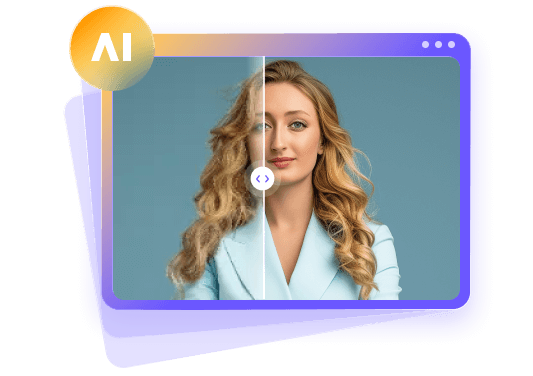
HitPaw FotorPea is an AI photo enhancement tool for Windows and macOS built around neural network models trained on high-resolution image data. Unlike standard resizing, it reconstructs detail at the pixel level. It was previously called HitPaw Photo Enhancer and has since expanded significantly in model count and resolution ceiling.
Key Features of HitPaw FotorPea (AI Enhancer):
- 9 specialized AI models: General, Face, Denoise, Blur Repair, Colorize, Upscale, Low-Light, Text, and Animation. Each targets a specific image problem rather than applying a one-size-fits-all pass.
- Upscale to 8K resolution: Scale options of 2x, 4x, and 8x with output support up to 16K for large-format work.
- One-click processing: The AI reads your image and selects the right enhancement parameters automatically. No sliders to calibrate.
- Batch processing: Load and upscale multiple Nano Banana images in one run, useful when you are working through a full content set.
- Blur repair and noise reduction: Addresses compression artifacts, motion blur, and the digital grain that AI-generated images often carry in background areas.
- Generate images with 13+ AI models: It support 13+ AI image generation models for your needs, like Nano Banana, Nano Banana 2, and so on.



How to Use HitPaw FotorPea to Upscale Nano Banana Images:
1. Download and install HitPaw FotorPea.
Open the app and select 'Enhance Photos Now' from the main screen.
2. Import your Nano Banana image.
Drag the file into the AI Enhancer panel, or click 'Choose Files' to browse. Supported formats include JPG, PNG, WEBP, and TIFF.
3. Choose the right AI model.
Start with the General Model for most images. Switch to the Face Model if the image features a person. Use Denoise for grainy outputs with visible noise in flat areas.
4. Preview, then export.
Click 'Preview' to inspect the result at full size. Export when you are satisfied. The file saves at your selected resolution.
Best Use Cases for Nano Banana Upscaling with HitPaw FotorPea:
- Social media content: Instagram carousels, YouTube thumbnails, and banner ads all require sharp edges at full display size. FotorPea eliminates the soft, AI-generated look that gives away under-resolution images.
- E-commerce product images: Product visuals get zoomed by shoppers. Reconstructed detail from FotorPea makes AI-generated product images hold up at high zoom without falling apart.
- Print materials: Flyers, packaging, and posters need at least 300 DPI at print dimensions. Upscaling through FotorPea makes Nano Banana images print-ready.
- Presentation decks: A pixelated slide image signals low effort. High-resolution visuals made this way look indistinguishable from stock photography at typical presentation sizes.
For one-off enhancements without installing software, HitPaw FotorPea also offers a browser-based version. It handles single images well and requires no setup. For batch work or maximum resolution control, the desktop version is the better choice.
Part 4: Pro Tips to Get Better Upscaling Results with Nano Banana
1. Use high-quality source images
Garbage in, garbage out applies directly here. If the Nano Banana image already has soft areas or compression artifacts at native size, upscaling amplifies those problems rather than hiding them. Generate at the highest resolution your current plan allows and save in PNG before running anything through an upscaler.
2. Avoid excessive zooming during generation
Shoot wider in your Nano Banana prompt and do any cropping afterward in your editor. You preserve more of the original image data that way.
3. Front-load quality descriptors in your prompt
Put your quality descriptors at the very start: '8K resolution, sharp focus, high fidelity detail' before you describe the actual subject.
4. Keep style descriptors consistent across a set
Photorealistic and product photography styles upscale more cleanly than heavily stylized or illustrated outputs. If you are producing a content series, lock your style descriptors early and keep them identical across prompts.
FAQs of Nano Banana Upscaler
Nano Banana Pro supports 4K output natively. The standard free model generates at lower dimensions more suited to web use. If you need true 4K from any Nano Banana image regardless of your plan, running it through a dedicated nano banana upscaler like HitPaw FotorPea is the more reliable method. It gets you there consistently without depending on which version of the model you are using.
The standard version of Nano Banana is free through the Gemini app and Google AI Studio. Pro access, which includes higher resolution output and advanced editing features, requires a Google AI Pro or Ultra subscription. Third-party platforms that integrate Nano Banana set their own pricing, with some offering free tiers and paid plans typically starting around 15 dollars per month.
Yes. HitPaw FotorPea has a free trial that lets you preview the enhancement result before committing. The online version of HitPaw Photo Enhancer processes single images free with no software installation required. Both are worth testing before purchasing if you want to see the quality improvement on your specific type of Nano Banana output.
Nano Banana Pro outputs up to 4K resolution. It also includes improved text sharpness, better consistency across multi-step edits, and stronger detail retention compared to the standard Flash model. For outputs that need to go beyond 4K, such as large-format print or high-resolution video production, upscaling through HitPaw FotorPea at 8x gets you to 8K from a Pro-quality base image.
Final Words
Most people hit the Nano Banana resolution ceiling not because the tool is limited, but because they are treating it like a finished output rather than a starting point. The images it generates are strong at web size. The gap shows up when those images move into professional contexts that demand more.
Closing that gap is a two-step process: generate at the highest quality Nano Banana allows using tight, front-loaded prompts, then bring the result into HitPaw FotorPea for AI-driven upscaling that rebuilds actual detail rather than approximating it. The combination gets you to true 4K with the kind of edge sharpness and texture clarity that passes for professional photography at a glance.
Download HitPaw FotorPea and run your next Nano Banana image through the 4x Upscale Model. The difference in a side-by-side preview is the fastest argument for making it part of your regular workflow.
Leave a Comment
Create your review for HitPaw articles