





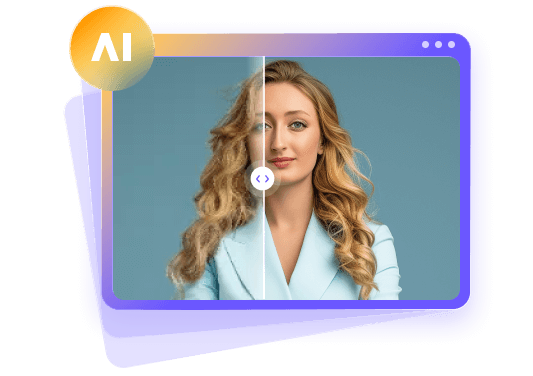
How to Turn an Old Photo Into a New-Looking Photo
 By Daniel Walker
Grandma's photo box is falling apart. The corners are torn, the color has gone blotchy and sepia, and half of Uncle Ray's face is scratched out. Sound familiar? An old photo to new photo converter uses AI to fix exactly that kind of damage, sharpening blur, correcting faded color, filling in scratches without anyone needing to touch a layer's panel. Below, I'll go through what these tools actually do, compare six well-known AI photo restoration apps, and walk through a real step-by-step example.
Part 1: What Can an Old Photo to New Photo Converter Do?
Not every converter works the same way, but most stack a handful of AI models on top of each other. Roughly, here's what you're getting.
- Remove scratches and damage from the AI spots, torn edges, creases, and scuffs, then rebuild the missing texture so it doesn't look patched over.
- Fix blur and noise. Old film grain and soft focus get cleaned up by models trained specifically for that kind of degradation.
- Restore faded colors, pulling sepia tones and yellowing back toward something closer to the original.
- Recovering facial details usually the trickiest part, since rebuilding eyes, skin texture, and expression convincingly takes more than a simple sharpen filter.
- Upscale old photos so small or low-resolution prints can be enlarged for printing without turning into a blurry mess.
Part 2: 6 Best Old Photo to New Photo Converters
Here are six of the more talked-about photo restoration tools out there right now, compared on platform, price, and what each one is actually good for.
| Tool | Platform | Free Option | Best For |
|---|---|---|---|
| HitPaw FotorPea | Windows, Mac | Free trial | All-in-one restoration + AI generation |
| Adobe Photoshop | Windows, Mac | Trial only (paid) | Professional, manual retouching |
| Remini | iOS, Android, Web | Freemium | Quick mobile face enhancement |
| MyHeritage | Web | Freemium | Family history & genealogy photos |
| Fotor | Web | Freemium | Simple online, one-click editing |
| VanceAI | Web | Freemium (credits) | Modular, budget-friendly restoration |
1. HitPaw FotorPea - AI Old Photo Restoration
HitPaw FotorPea is a Windows and Mac app that combines AI photo restoration with image generation in a single workspace. If you'd rather not fuss with settings, this is probably the one to start with, most of the heavy lifting happens automatically.
HitPaw FotorPea is HitPaw's AI photo enhancer and AI photo generator.




Key restoration features
- Automatic scratch and crease repair
- AI-powered noise detection that recommends the right model for the job
- A face model built specifically for portrait clarity
- One-click colorization for black-and-white shots
- Upscaling up to 8K resolution
 Pros
Pros
- Barely any manual work required to get a decent result
- Restoration and AI image generation live in the same app
- Can batch-process a whole folder of photos at once
 Cons
Cons
- Full feature set is locked behind a paid plan
- Desktop only - there's no mobile app
How to Turn an Old Photo Into a New-Looking Photo with HitPaw FotorPea
Step 1.Drag your old photo, scanned or just photographed on your phone, into HitPaw FotorPea. It reads the resolution, noise level, and damage type on its own and suggests a restoration model.

Step 2.Pick whichever model matches what's actually wrong with the photo scratches, noise, faded color and let it run. Most images finish processing in a few seconds.
Step 3.Turn on the face model to sharpen eyes and skin texture, check the before-and-after slider, and export once it looks right to you not necessarily perfect, just right.
2. Adobe Photoshop - Professional Photo Restoration
Photoshop won't hold your hand. There's no magic restore button instead you get Neural Filters plus the classic manual toolkit (Spot Healing Brush, Clone Stamp, Camera Raw), which means more control but also a lot more time at the keyboard.
Key restoration features
- Neural Filters for colorization and detail enhancement
- Spot Healing Brush and Clone Stamp for manual scratch removal
- Camera Raw for precise color and exposure correction
Pros
- Nothing else matches its precision
- Still the standard professionals actually use
Cons
- Takes real practice before results look good
- Subscription-only, and restoration is slow going by hand
3. Remini - AI Photo Restoration
Remini's whole pitch is speed. Point your phone at an old selfie or portrait, tap once, and the app sharpens faces almost instantly. There's a web version too, but honestly it's built for mobile.
Key restoration features
- One-tap AI face enhancement
- Photo and video quality upscaling
- Batch enhancement for multiple images
- Simple, beginner-friendly mobile interface
Pros
- About as fast and easy as it gets
- Genuinely strong results on faces specifically
Cons
- Not much room to fine-tune anything
- Free tier is fairly limited, and skin can end up over-smoothed
4. MyHeritage - Old Photo Restoration
MyHeritage isn't really a photo editor it's a genealogy platform that happens to have solid restoration tools built in. Photo Enhancer and in Color are aimed squarely at old family portraits, and Deep Nostalgia will even animate a still photo if that's your thing.
Key restoration features
- Photo Enhancer for sharpening and detail recovery
- In Color tool for black-and-white colorization
- Deep Nostalgia animation feature
- Built into a broader family-tree research platform
Pros
- Great fit if you're already building a family tree
- Restoration and colorization work well side by side
Cons
- The best features sit behind a subscription
- Not meant for general-purpose photo editing
5. Fotor - Online AI Photo Restoration
Fotor lives entirely in your browser, and its old photo restoration effect is basically a one-click option tucked inside a much bigger design suite.
Key restoration features
- One-click old photo restoration effect
- AI-based denoising and sharpening
- Built-in color correction and filters
- No installation - it runs straight from a browser tab
Pros
- Nothing to download, works from any browser
- Also doubles as a basic design tool
Cons
- Free version doesn't give you much to work with
- Results aren't as sharp as dedicated restoration apps
6. VanceAI - AI Old Photo Restorer
VanceAI splits the job up; there's a dedicated old photo restorer, plus separate upscaling and denoising tools you run one after another instead of all at once.
Key restoration features
- Dedicated AI old photo restoration model
- Separate upscaler and denoiser tools
- Batch processing for multiple images
- Credit-based free trial
Pros
- Lets you control each step individually
- Lightweight and browser-based, nothing to install
Cons
- Credits add up fast if you're restoring a lot of photos
- More clicking around than an all-in-one app
Part 3: Tips for Restoring Old Photos
A little care before you even open an app goes a long way toward restoring old photos well, no matter which tool you end up using.
- Start with the best scan you can get. A flatbed scan at 300 DPI beats a phone photo of a photo almost every time, more detail in means more detail out.
- Don't overdo the face enhancement. Push those sliders too far, and people start looking waxy or oddly smooth. Natural texture usually reads better than a perfectly airbrushed face.
- Keep the original file. Save the untouched scan somewhere safe so you can start over with a different tool later if you're not happy with the first pass.
FAQs About Old Photo Restoration
It's software or an app that uses AI to clean up an old photograph patching damage, sharpening detail, fixing color, and boosting resolution so you end up with a sharper, more presentable version of the original.
Scan it, or photograph it, at the highest resolution you can manage. Upload it to a restoration tool, run scratch removal and denoising, adjust color if needed, then finish with face enhancement before exporting.
Mostly, yes. It can strip out scratches, sharpen blur, bring back color, and upscale resolution, though how good the result looks still depends on how much detail survived in the original.
In most cases. Tears, creases, missing chunks, heavy grain AI handles all of that reasonably well now. Really badly damaged photos might still need a bit of manual touch-up on top.
Depends what you actually need. HitPaw FotorPea is the easiest all-in-one option, Photoshop is for anyone who wants full manual control, and Remini or Fotor work fine for a quick fix from your phone or browser.
Final Verdict
None of these six tools are a bad choice each one can turn a scratched-up, faded print into something worth putting back on the wall. If you'd rather not fiddle with settings, an old-to-new photo converter like HitPaw FotorPea is probably the fastest way to go. If you're a professional who wants total control, Photoshop still wins. Either way: scan at the highest quality you can manage, hold onto the original, and go bring some old memories back.
Leave a Comment
Create your review for HitPaw articles


