



Gyroflow Stabilizer: Smooth Your Shaky Footage with Gyro-Based Precision
 By Daniel Walker
Gyroflow is an open source stabilization tool that uses gyroscope motion data recorded alongside video to recreate camera motion and correct shakes with surgical accuracy. Filmmakers, FPV pilots, and action camera users rely on Gyroflow to stabilize footage while preserving natural camera movement and minimizing warping. This article explains what the Gyroflow stabilizer does, which cameras work best, system compatibility, step-by-step usage, and an AI alternative for fast or batch stabilization.
Part 1. What Is Gyroflow Stabilizer?
Gyroflow stabilizer is software that uses gyro and IMU data embedded or paired with video to reconstruct true camera orientation at each frame and then re-render a stabilized view of the scene. Because it is gyro-driven rather than purely frame-to-frame tracking, Gyroflow can deliver more accurate stabilization for fast, rotational motion such as drone flights and action camera footage. Gyroflow is free and available across desktop and mobile platforms, and you can find official downloads on the project site.
1. Key Features of Gyroflow Stabilization
- Gyro-driven stabilization that recreates real camera motion for accurate corrections.
- Multiple stabilization modes including 3D options and modes tuned for FPV footage.
- Rolling shutter correction to reduce skew and wobble with CMOS sensors.
- FOV and lens correction controls to balance crop versus visible scene.
- Preview and real-time tweaking so you can test settings before export.
- Support for OpenFX and Adobe plugins to integrate into editing workflows.
2. Cameras Supported By Gyroflow
Gyroflow supports devices that record gyro or IMU data alongside video. Common supported sources include:
- Action cameras: GoPro series, DJI Action 2/4/5, Insta360 models, Runcam, Hawkeye.
- Drones: DJI Avata, Avata2, Neo, O3 Air Unit and other flight controllers that provide gyro logs.
- Mirrorless cameras: Certain Sony α, FX, RX and ZV models when paired with external gyro-logging solutions.
- Cinema cameras:Blackmagic Pocket Cinema Camera models and some RED models when gyro data is available.
- Other sources: Betaflight, ArduPilot, WitMotion and similar flight or log formats.
- Gyroflow native format: .gcsv files exported by some cameras and tools.
- Mobile gyro-logging apps for Android and iOS that produce compatible logs.
Note: Gyroflow requires accurate gyro data. Cameras that do not record gyro data internally cannot be stabilized with Gyroflow unless you provide an external matching gyro log.
3. Gyroflow Compatibility and Plug-in Installation
- Gyroflow for Windows: Windows 10 64-bit (build 1809 or later) recommended.
- Gyroflow for Linux: Debian 10+, Ubuntu 18.10+, CentOS 8.2+, openSUSE 15.3+ recommended.
- Gyroflow for Mac: macOS 10.14 or later, with universal builds for Intel and Apple Silicon.
- Mobile: Android 6+ and iOS 14+ for the mobile apps.
You can download installers, nightly builds, and plugins from the official site and the project repositories. For plugin users there are OpenFX and Adobe plugin builds for integration into NLEs.
Part 2. How to Stabilize Footage in Gyroflow?
Stabilizing footage in Gyroflow is fast and reliable when you have matching gyro logs. The process is: import your video and gyro data, pick a stabilization mode, tweak smoothness and lens settings, preview in real time, then export. Below are clear, rewritten steps that follow best practices for Gyroflow stabilization.
Step 1. Import your video files
Open Gyroflow and drag and drop your video into the app. If your recording is split into multiple files from the same session, select all parts and import them together; Gyroflow will offer to join them so stabilization treats the clip as a continuous recording.

Step 2. Check for gyro traces and add missing data
When gyro data is present, the timeline shows three traces for X, Y, and Z axes. If those traces are missing the file likely has no embedded gyro data. In that case, import the corresponding gyro log (for example a CSV or .gcsv) via the Motion Data area so every frame has matching motion information.
Step 3. Use lens profiles or create one
If Gyroflow recognizes a lens profile for your camera it will load it automatically on import. If no profile is found, select a built-in profile or create a custom one. Accurate lens profiles reduce distortion and improve stabilization results.
Step 4. Sync gyro data with the video
For GoPro and DJI cameras the gyro should sync automatically using timestamps. If sync looks off for other cameras, try the Auto Sync option under Stabilization. If Auto Sync is not perfect, nudge the Offset slider manually until the gyro traces align correctly with visible motion.
Step 5. (Optional) use Optical Flow as a secondary check
Optical Flow analyzes frame-to-frame motion and can help verify sync or stabilization, but it can be confused by moving foreground subjects or changing light. Use it as a secondary tool rather than the primary sync method.
Step 6. Select a stabilization mode
Choose a mode such as Plain 3D for a Reelsteady style result or Default for balanced FPV smoothing. Each mode has different behavior; switch modes to see which best matches your footage and artistic intent. Click Advanced to access more detailed options.
Step 7. Adjust Smoothness and Max Smoothness
Smoothness determines how much the Gyroflow stabilizer evens out camera motion. Higher values produce steadier footage but increase cropping. A typical starting range is 10% to 30% for relatively stable flights. Increase Smoothness for very shaky clips but monitor crop and framing. Use the Max Smoothness sliders to control the temporal smoothing window; lower values reduce cropping but also reduce the amount of correction.
Step 8. Tweak Lens Correction and FOV
Set Lens Correction between about 25% and 100% depending on how much of the fisheye look you want to remove. Under Advanced, use the FOV slider to control how much of the original frame remains visible after stabilization. Increase FOV until you see red border warnings in the timeline, then back off slightly to avoid black edges.
Step 9. Enable Rolling Shutter Correction if needed
If your footage shows skew or wobble from a CMOS rolling shutter - common during fast movement - turn on Rolling Shutter Correction and increase it until the distortion is reduced. This can greatly improve image fidelity for high-vibration shots.
Step 10. Preview the result and fine tune
Use the Play preview to inspect the stabilized clip in real time. Make small adjustments to Smoothness, FOV, lens correction, or offset and re-preview until motion looks natural and framing is acceptable.
Step 11. Export with appropriate settings
When satisfied, export your stabilized video. Choose codec, resolution, bitrate, and file format that match your delivery needs. Keep original resolution when possible, or pick an output (for example for social media or editing) and confirm export speed and quality settings before rendering.
Part 3. Best Gyroflow Stabilizer Alternative to Fix Shaky Video with AI
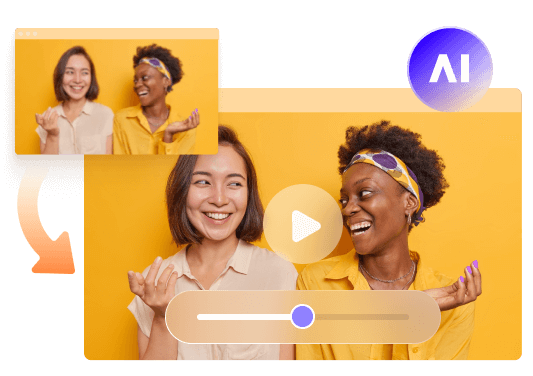
If you want a fast, AI-powered route to stabilize and enhance many clips with minimal manual tuning, HitPaw VikPea is a strong alternative. HitPaw VikPea uses AI models to detect and correct shake, reduce noise, and optionally upscale video up to 4K or 8K. It is user-friendly for creators who need batch processing, a preview before export, and straightforward stabilization without building gyro logs. Below are key features and a simple workflow.
- AI stabilization that automatically detects and corrects shaky footage with minimal input.
- Batch processing to apply the same AI model to many files at once.
- Upscaling up to 4K or 8K to improve output resolution for social or professional delivery.
- Preview mode with side-by-side or split comparisons before export.
- Noise reduction and clarity enhancement to restore details.
- Flexible export settings including codecs, bitrate, and format selection.



Step 1.Download and install the latest HitPaw VikPea for Windows or Mac. Launch the app and open AI Toolbox, then select Stabilization.
Step 2.Click Import or drag and drop the videos you want to stabilize. Use the plus button to batch import multiple files so the same AI model applies to all clips.
Step 3.Under Export Settings choose your desired resolution and output options. Use Preview to see a sample of the AI-stabilized result. When satisfied, click Export to render and save the stabilized video.
Part 4. Frequently Asked Questions on Gyroflow
A good starting point is Smoothness between 10 percent and 30 percent for most FPV flights. Increase smoothness for shakier footage but watch the resulting crop.
Yes. Gyroflow excels when accurate gyro logs are available, offering precise stabilization with less warping than purely frame-tracking methods. It is widely used in drone and action footage workflows.
Not directly. Gyroflow depends on gyro or IMU logs to compute accurate stabilization. If no gyro data exists you must use non-gyro stabilizers or capture an external matching gyro log.
Gyroflow recreates the camera orientation in 3D for each frame from gyro logs, then computes a stabilized camera path and renders the frames from that new viewpoint, applying lens and rolling shutter corrections as needed.
Conclusion
Gyroflow stabilizer is a powerful, gyro-driven solution for creators who can supply accurate gyro or IMU logs. It offers precise stabilization, rolling shutter correction, and plugin support for professional workflows. For users who need a fast, easy, AI-driven alternative that does not require gyro data, HitPaw VikPea provides automated stabilization, batch processing, upscaling, and preview tools. For downloads and the latest releases, check the official Gyroflow site and documentation, and consider HitPaw VikPea if you prefer an AI-first smoothing workflow.
Leave a Comment
Create your review for HitPaw articles